
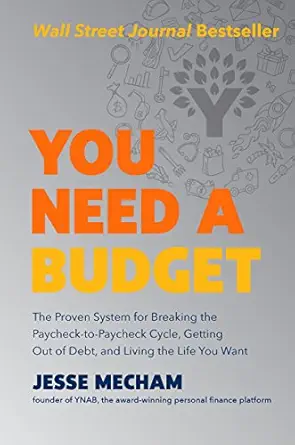
That little life plan? It’s actually a budget. Yes, a budget. You need one. I need one. We all need a budget– no matter how much money you have (or don’t have). You picked up this book, so you probably already know that, but the idea of budgeting may still scare you. If you’re worried it will be too rigid, restricting, and unforgiving, it’s time to look at budgeting from a different angle…
-Jesse Mecham
A lesson in financial wellness…
As an Amazon Affiliate it is policy to inform you that this is an advertisement. However, this is still a reflection of a great book that I’ve read many times over. I believe it would benefit any who may read it. You can find the link for it in my references located at the bottom of this page.

Get it together… Now.
It’s time to take control of your finances. It’s no mystery that you need to make more money. You and everyone else. But how much is enough? How much exactly? That is what your budget would show you. To make more money is a simple enough matter, just go out and get it. Get another job or take on more responsibility at your current job. Sell something that somebody needs. Sometimes, the right answer is working your ass off. However, it doesn’t have to last forever. Just until you’ve made enough. Without a budget, you will work yourself into the dirt. Nothing will stress you out quite like money problems. Eventually we all stress over it regardless of how much money we make. Some of you might be freaking out about what to do next as I write this. Hopefully, after we are done here that will be a thing of the past. Because no matter how low your income might be or how much debt you have, there is always a way to tackle your seemingly insurmountable financial problems.
Let’s get something clear, I’m not here to tell you what to do with your money. Only you can navigate your problems and quite frankly I don’t care nor am I qualified enough to take an active of a role in your finances. I’m only offering guidance and you do with it what you will. It’s the same as always. Only tips, never advice. You don’t need any fancy budgeting tools; besides I don’t have one to offer you. You could use an excel spreadsheet or you could use your bank’s budgeting tool if they offer one, which most do. You could even go old school and keep a journal. All that matters is that you have a way to track what you are doing. A budget is something you should create once a month, but anytime you make a purchase that goes against your plan, you must reorganize. Whenever you buy something, you shouldn’t check your bank account. You should check your budget. For example, say you wanted to buy a used car. Within the past six months, did you list that car on your budget? Forget the savings account for a moment, did you write it down? Did you plan for the car? If you didn’t, then would you be prepared to sacrifice your current priority to get it? Again, I’m not telling what to do here. A budget isn’t a rigid guideline for you; it is just a plan. A variable plan which should reflect what is most important to you. Priorities change and most people need a vehicle. Who knows? Maybe your old car took a shit, and you need a replacement right away. But no matter what emergencies may come, you must remain organized.
Budgeting is not for the weak-minded. Just the idea of making a budget could paralyze us. Some people simply cannot handle that level of accountability. Others may feel overwhelmed and have no idea where to start. Or maybe they just have no idea what a good budget is supposed to look like. First, I’m going to need you to take a deep breath. You’ve got this, okay? Stop worrying about whether or not you can afford something, because you aren’t supposed to be spending money, you are supposed to be putting your money to work. Budgeting isn’t just something that broke people do. Actually, it’s quite opposite. Budgeting is exactly how most people get rich and stay that way. Say you were running a business; how much sense would it make to NOT hire an accountant? The reality is that budgeting is something that broke people (or soon to be broke) choose to avoid.

How to budget
Before we go more into details, I must warn you about credit cards. You either need to get smarter about how you use your credit cards or cut them up. Credit cards are so dangerous that I almost consider them weapons. The problem with credit cards is that you are spending money you do not have. It is instant debt accumulation. To fix this issue, you should never borrow more than you know you can pay back. You shouldn’t have a credit card limit that is higher than your monthly income. It should hardly amount to half of it. You must use your credit card as an extension of your money. It is not a child’s toy. It is not a fool’s emergency fund. It is a tool for those who understand how money works. You must never use it more than once a month, and when you use it, you must visualize your paycheck being cut into fractions.
For those of you who are extra broke, you will have to come up with a weekly budget for at least the first two or three months. Only once you’ve built up a savings account will you be able to settle for once a month. Don’t forget to factor yourself into the budget. I’m sure you’ve heard of “paying yourself first” correct? That’s a good tip. You’ll still need fun money. You still need to get out and have a good time; you only live once. Any money you decide to give anyone else must come from your allowance as well. Do not break your budget for anyone. Period. For those with unpredictable cash flows such as commissioned workers, you’ll have even less room for error than most. It’s important to remain stable during bad weeks. In the case of an emergency remember that most collectors will work with you if you talk to them. You could split a payment or even push it back in some cases. This isn’t a given, but the worst thing you can do is not communicate with those you are obligated to when times are rough.
Pretty much everyone has at least tried budgeting before. But a lot of people fail because they have the wrong idea about money. If you’re going to get it right this time, we’re going to have to change that. When budgeting you need to track two things, your priority and your obligations. Your obligations are the non-negotiables which you must pay in full each month. Your priority is what you are working toward. Remember that you cannot have more than one priority. You will most likely not have enough money for everything you are trying to do. When drawing up your budget you must be as exact as possible, not just with your spending but with your income as well. Start with the money you have right now because you can never be certain about the future, you can only plan the best that you can. You can’t count money that you haven’t made yet. It’s an anxiety attack waiting to happen. If you have a low balance just embrace it for now, because it’s the truth. I’m not telling you to ignore the pit in your stomach; just the opposite actually. Use that uneasiness to your advantage. It’s your body urging you to think of a budget. Once you have one it will go away, I promise. For some of your problems it’s as easy as making a few cuts. For others you will need to get more creative. It can get a little fun once you’re used to it. But what’s more important is the satisfaction you will get from doing something that is hard for most people. Imagine listening to other’s financial problems and no longer being able to relate.
Kill the debt
You must avoid debt at all costs. We build our savings because we might not be sure when the next problem will occur, but we can at least say for certain that it will cost more than 0$ to fix it. You don’t have to save thousands each month. Even if you can barely save one hundred dollars, make sure it’s at least more than 0$. Trust me, you don’t want to use your credit card as a bailout. In fact, you should avoid taking any loan unless you are prepared to pay off the debt. If what you want is to improve your credit in general, you should focus your money on your debt. A low credit score means that you owe people money; plain and simple. That’s the word on the street. Change that as soon as you can. While you have debt, you are spending money you don’t actually have. If you have a million dollars in your pocket, but have two million dollars in debt, you are broke.
The ultimate goal of budgeting is (you guessed it) saving money. But more than that, it’s about acquiring old money. I’m sure you’ve heard of the term. You gain more appreciation for your old money the longer you have it. It is proof that you are your greatest asset. It is evidence of your self-control. The older your money is the more beautiful it becomes. Imagine how cute your five day old money would be. Now imagine how pretty it would be after 5 months. Now picture how gorgeous it would be after 5 years. I bet it would be your pride and joy. Old money is some beautiful shit, and I challenge you to see for yourself. However, you cannot claim to have old money until you have paid off your debts.
Gathering old money doesn’t mean never touching your savings account. If you are starting with absolutely nothing in your savings, you must use your savings something like a money yo-yo. You put a little something aside for next month so that you may use less of your future income to pay your obligations. That will allow you to put a little more into your savings for the following month’s bills. Once you’ve gathered the proper momentum, your bills will be paid ahead of time while still being prepared for whatever may come. That’s the beauty of budgeting. Without a budget you will have a stack of bills waiting for your money. With a budget you will have a stack of money waiting for your bills. You must reverse the flow.
My issue with debt is that it represents your past mistakes. It’s undeniable proof that you are a liability. That is why you must get rid of it. You can’t climb the mountain with all that extra weight. If you are debt-free, you are automatically richer than most of the people around you. Mortgages may be expensive, but houses are inflation resistant. If you have a mortgage, work on paying it off as soon as possible, even though it is technically considered “good debt,” in my opinion, all debt is bad debt. Swing your money yo-yo until you’ve killed it dead. If you have multiple debts it is recommended to pay off the least expensive obligation first. The momentum you build up with your “savings yo-yo” will help you to hit the next obligation harder, and so on and so forth.

Don’t ever stop
After you’ve paid off your debts, keep the momentum going. Your obligations have two subcategories, predictable and inevitable. Your predictable obligations speak for themselves: rent, car insurance, electric and water bills, phone bill, etc. Predictable obligations are easy to prepare for because you know exactly how much it will cost and when you would need the money. Inevitable obligations are usually what ends up derailing us or bringing us to a screeching halt. You never know when your pet is going to get sick, or when your car is going to need repairs, or if a tool gets stolen or lost. Inevitable obligations represent all the things that could possibly go wrong in your life. You don’t know when it would happen, but you know for sure that it will one day. With that in mind, it would be wise to have something prepared. Anything is better than nothing. Preparing for the inevitable is the essence of survival. Without a budget you will not survive.
You can only focus on your priorities once you’ve gotten ahead of your obligations. Obligations can be cut, but it will take some creativity on your part. For example, imagine you must afford both a car and a house on your income and you are not making enough. In a situation like that, you should consider moving closer to your job. That way, even if you must pay a little more in housing, you could cut your losses on your vehicle until you can afford to pay in cash. I would suggest buying used. For those of you who have paid off your car note, how did it feel not having to spend that money anymore? It felt like you had more of a paycheck, right? What if I told you that you could enjoy such a feeling even before you’ve completely paid off an obligation? That’s what budgeting could do for you. Imagine consistently having the money for your bills before they come out. One day, I would like for you to experience a full paycheck. That’s when you can really start getting what you want.
You cannot forget your emergency fund. Once you have gotten ahead of what is predictable and have planned for the inevitable, you must remain flexible for the unforeseen. Emergencies tend to pop up completely out of nowhere. An emergency forces you to scrap everything and start over. But that’s just how life goes sometimes. It’s a crazy and unpredictable world. But that’s no reason to give up. If you have to start all over again then do it. It could always be worse. The act of budgeting is an act of accountability. Accountability in simple terms is living with the truth. Without a budget you are operating on pure delusion. You would be too caught up in what you can and can’t afford. You would continue to walk right into the avoidable problems, because you have no direction. It is a bit troubling how comfortable some people can get with having absolutely no control over their lives.
Once you’ve gotten used to budgeting, it changes the way you think. When you see something you want, you will no longer wonder if you can afford it. Instead, you would be wondering what you would give up to get it. You would start moving a bunch of numbers around in your head while considering the trade offs. Because you won’t forget that obtaining something you want means sacrificing something else you want. You will develop an eye for value and will be able to accurately weigh whatever you see against your current priority. Once you get your finances under control do not be in a rush to upgrade your lifestyle. Budgeting isn’t something you do until you don’t need it anymore. You will always need one. You reach the top by climbing the mountain, not by building a rocket.

Budgeting with a family
The subject of budgeting gives me a unique opportunity to talk about relationships. We like to pretend that money isn’t important when considering our significant others, but that is a delusion; a self-inflicted one at that. Eventually, you two will need to have a serious conversation about money. You will need to know each other’s plan for the future and how you will plan on getting there. You need to be aware of each other’s debt and how you two will plan on paying it off. You each must be aware of how the other makes their money. Most importantly, you must be aware of how much money your significant other spends. But this conversation doesn’t have to be stressful. Budgeting itself shouldn’t be stressful. You know you have someone special once you have created a suitable budget together.
When budgeting with your significant other, you are literally planning your lives together. This is where a lot of people can’t help but to become a bit controlling. There will be times where one will have to check the other’s impulses, but you must be able to trust each other. If it’s going to work between you two, you will have to be a team. If you cannot budget together, you are not compatible. It may take a bit of time to reach an agreeable budget, as you will likely come from different backgrounds, but it is the only way to avoid becoming each other’s financial burden. Budgeting with your love requires the utmost honesty from the both of you. The wrong time to come clean about breaking the budget is when an obligatory payment fails to go through. Like I said previously, this doesn’t have to be a stressful experience. You have to be comfortable talking to each other about your expenses. So why not make it a date night? Order some good food, Curl up on a couch, put on a shitty movie (they’re all shit nowadays), bust out the tablet and make a plan together. When you think about it, budgeting together is downright romantic.
No matter how well things are going between you and your love, I advise against merging bank accounts. There must be something of a boundary between you and your significant other. It is important for each of you to have money that the other cannot have access to unless you permit it; no matter what happens. This is for the sake of the relationship, because maintaining that boundary is the same as keeping a promise. A promise that you will never let the other down. Your obligations are shared, but your priorities must remain separate. Typically, if priorities are shared that is because one is controlling the other. This isn’t unity, this is possession. Boundaries are important because even if you find a good match, if you lose yourself, the relationship will deteriorate over time anyway. Then you will be left broken. Too many people forget themselves within a union which is why “marriage” shall remain rookie mistake number 7.
For those of you with children, it’s important to teach them about money while you can. This is why allowances are a thing. It isn’t about spoiling your kids; you are trying to teach them how to budget. It would go something like this… “Alright kiddo, you could either blow your money on candy each month, or you could save up for a new game that you may or may not get for Christmas. I’m not going to tell you what to do with your money, but I will be interested in the choices you make. Here ya go kid, $15. Don’t spend it all in one place.” That’s more or less how you want to go about it.

Delay your gratification
Self-control shouldn’t feel like self-deprivation. Delayed gratification is an acquired taste. It’s going to suck really bad in the beginning. But the more you do it, the easier it gets. Give your brain some time to get used to it. You will eventually enjoy the freedom that it will allow you. But don’t give up. Even if you break the budget, you can either unfuck that somehow or embrace the suck, start over, and do better. Build the momentum. Even if things don’t work out, you have to keep trying. Because it’s your only way out. You have to keep prioritizing. You can’t run out of ideas. No matter how impossible it seems, you will climb that mountain.
References and photos
You need a budget – Jesse Mecham
Invincible – Robert Kirkman